Dolomites · The Marmolada · Via Caprile and Malga Ciapela
Passo Fedaia from Caprile: 14 km at 7.5% to 2,057 m
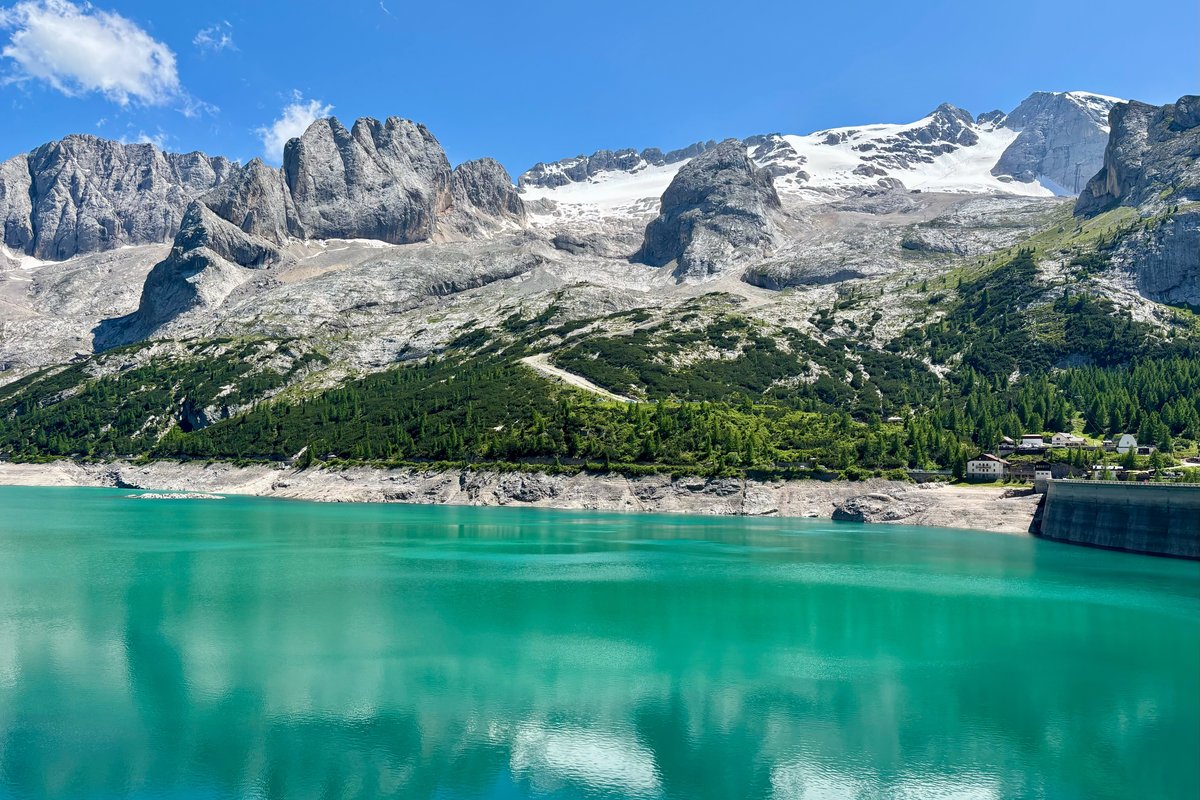
The Passo Fedaia, which riders often just call the Marmolada, crosses the ridge between the Agordino in Veneto and Val di Fassa in Trentino, right below the highest mountain of the Dolomites. From Caprile it is about 14 km at 7.5% with 1,066 m of climbing to 2,057 m, according to CyclingCols. Those averages hide a climb of two halves: the first nine kilometres to Malga Ciapela are mostly gentle, and the last five average about 11%, starting with a long, almost dead-straight ramp. The Giro d'Italia has crossed the summit 15 times from 1975 to 2022, always from this side, and finished at the pass twice, in 2008 and 2022.
Quick facts
- Distance
- 14.0 km
- Average grade
- 7.5%
- Max grade
- ~15%
- Elevation gain
- 1,066 m
- Summit
- 2,057 m
The experience
The east side starts in Caprile at about 1,000 m and follows the SP641 (the old SS641) past Rocca Pietore, Sottoguda and Malga Ciapela to the Fedaia reservoir. CyclingCols gives 14.0 km at 7.5% with 1,066 m and a maximum of 15%, and salite.ch 14.1 km at 7.5% with 1,059 m. Rutas en Bici measures 14 km at 7.5% with 1,050 m, and CycloPeaks 14 km at 7.4% with 1,042 m. Climbfinder starts higher up the valley and gives 12.8 km at 7.8% with 1,002 m, with 15.8% for the steepest 100 m. Altigraphs, with yet another start and finish, gives 13.3 km at 8.4%. Italian Wikipedia, Climbfinder, CyclingCols and the Giro all put the pass at 2,057 m. The top is a plateau of about 2.5 km with the reservoir, built from 1950 to store meltwater from the Marmolada glacier. In the early 1950s a cosmic-ray laboratory stood at the foot of the dam, and Italian Wikipedia notes that Fermi, Blackett and Powell all spent time there.
Section by section, using CycloPeaks' kilometre profile: 3.1%, 8.3% (through Rocca Pietore), 4.1%, 3.8%, 2.8%, 7.3%, 6.8%, 5.6% and 7.0% for the first nine kilometres. That is about 5.4% on average, with a few short dips; Climbfinder reviewers describe the lower part as up, flat and even downhill in places. Then come 11.9%, 11.7%, 11.1%, 10.7% and 9.9% for the last five. Rutas en Bici's own measurement agrees on the shape: five kilometres in a row between 10.4% and 11.9%, with the steepest ramp, 15.3% over 200 m, around km 11.3. Just after Malga Ciapela (about 1,450 m) the road bends right and turns into the famous straight. The Giro describes it as nearly 3 km averaging 12% with a peak of 16%; Italian Wikipedia says about 3 km at over 12% with a maximum of 15%; Climbfinder reviewers remember 2 to 2.3 km without a single bend. It ends at the Capanna Bill hut. After that, the last 2.5 km climb in hairpins, still in double figures, and road signs warn of 15%.
The lower valley is the busier, more varied part, with villages, bars and several tunnels and galleries; Climbfinder reviewers and Rutas en Bici both advise a rear light, and Rutas en Bici a front one too. The Serrai di Sottoguda gorge, which the Giro rode through on its first visit, runs beside the main road; Climbfinder reviewers reported it closed for repairs in some recent years, so check before planning to ride through it. Traffic on the climb itself is light: of 39 Climbfinder traffic votes, 87% say light and none say heavy, although one reviewer found quite a few motorbikes on a June Sunday. Of 36 road-surface votes, 92% say good. Rutas en Bici's map shows water fountains around km 0.3 and km 8, so top up before Malga Ciapela. At the top there is a rifugio with food and drinks, and reviewers say the best view of the Marmolada glacier is a little further on, along the reservoir.
The Giro first came here in 1970, after the planned 1969 stage to Malga Ciapela was cancelled for snow and wind. That 1970 stage, won by Michele Dancelli, finished at Malga Ciapela, so the riders did not climb the steep last five kilometres. The Giro's own history page says the race organiser Vincenzo Torriani saved them for 1975, when Giancarlo Polidori was first over the top. Italian Wikipedia's table lists 15 summit crossings from 1975 to 2022, all from the Veneto side, and the stage of 2021 was shortened because of bad weather and left the Fedaia out. In 1998 Marco Pantani and Giuseppe Guerini attacked on the Marmolada, and Pantani took the pink jersey that evening. There have been two stage finishes at the pass: Emanuele Sella won in 2008, and in 2022 Alessandro Covi won stage 20 alone, while Jai Hindley dropped the leader Richard Carapaz on the steep upper part, about 3 km from the top, and took the pink jersey he kept to Verona.
The usual way to ride it as a loop is with the Passo Pordoi: from Canazei or Campitello over the Pordoi to Arabba, down the valley towards Caprile, up the Fedaia, and down the gentle west side to Canazei. Climbfinder reviewers describe exactly that loop, and the 2022 Giro stage also crossed the Pordoi before finishing on the Fedaia. The west side from Canazei is a much easier climb: CyclingCols gives 13.2 km at 4.6% with 621 m, and Italian Wikipedia about 5% on average. Coming down the east side, take care on the long straight: Italian Wikipedia notes that it allows very high speeds, and Rutas en Bici warns riders to control them.
Our time estimate for the rest of us (own calculation, rider and bike 80 kg in total, steady power and no wind, same model as our other guides, using CycloPeaks' kilometre profile of 14 km): about 1 hour 40 minutes at 150 watts, 1 hour 24 at 180 W and 1 hour 02 at 250 W. Gears by the same calculation, at 180 W: on the 7.5% average you would ride at about 10 km/h, which is about 65 pedal turns per minute on 34×28 and 75 on 34×32. On the 11% of the top section that drops to about 47 on 34×28, 53 on 34×32 and 56 on 34×34, and on the 15% ramp to about 34, 39 and 42. With a 34×28 you spend about 49 of the 84 minutes below 60 turns a minute; with a 34×34 still about 35. At 150 W even a 34×34 leaves you below 60 for about 50 minutes. Climbfinder's own advice is a compact with a 30, 32 or 34 at the back. Our view: fit the biggest cog your bike will take, because on this climb there is no gear that makes the top five kilometres comfortable.
Our own angle is a simple pacing rule: the Fedaia is two halves of equal time, not equal distance. At a steady 180 W the first nine kilometres to Malga Ciapela take about 42 minutes, and the last five take another 42. At 150 W it is 49 and 50 minutes. So when you pass Malga Ciapela you have done almost two thirds of the distance but only half the work. That changes how pushing early pays off. Riding the lower part at 200 W instead of 180 saves about 3.7 minutes. Dropping from 180 to 160 W on the top five kilometres costs about 5.2 minutes, because you are going so slowly there that every lost watt shows. If pushing early makes you fade by 20 W on the straight, you are about 1½ minutes slower in total, and more if it pushes your cadence down towards a grind. Ride the first half at a power you are sure you can hold for another 40 to 50 minutes uphill, eat something before Malga Ciapela, and treat the bend after the village as the real start of the climb. Expect it to be about 7 °C cooler at the top than in Caprile on a standard lapse rate.
Pro tips
- Mistake: judging it by the average: 7.5% sounds friendly, but the first nine kilometres average about 5.4% and the last five about 11%. Half your climbing time is spent on those last five.
- Mistake: racing the gentle half: 20 W extra before Malga Ciapela saves under 4 minutes; losing 20 W on the straight costs over 5. Hold back until the bend after the village.
- Fit your lowest gear: At 180 W even a 34×34 leaves you below 60 pedal turns a minute for about 35 minutes. A 34×28 makes it about 49.
- Bring lights: There are tunnels and galleries in the lower valley. A rear light is the minimum; Rutas en Bici also advises a front one.
- Fill up before the hard part: Fountains are marked around km 0.3 and km 8. Above Malga Ciapela there is little until the rifugio at the top.
- Ride on to the reservoir: The best view of the Marmolada glacier is a little past the summit, along the lake. Then take care on the fast straight if you go back down.
Estimate your time up Passo Fedaia
By our model, a 72 kg rider on an 8 kg bike holding 216 W (3 W/kg) needs about 1:11 for the 14 km and 1,066 m of Passo Fedaia. Enter your weight, your bike's weight and the power you can hold for about an hour of climbing.
Estimated time: 1:11:14
More about the climb time calculator ·
Steady power, no wind, no stops, and the average grade of the whole climb. Steep ramps, flat sections and descents are only evened out roughly, so irregular climbs will be less accurate. Your values are saved only in this browser.
More climbs in Italy
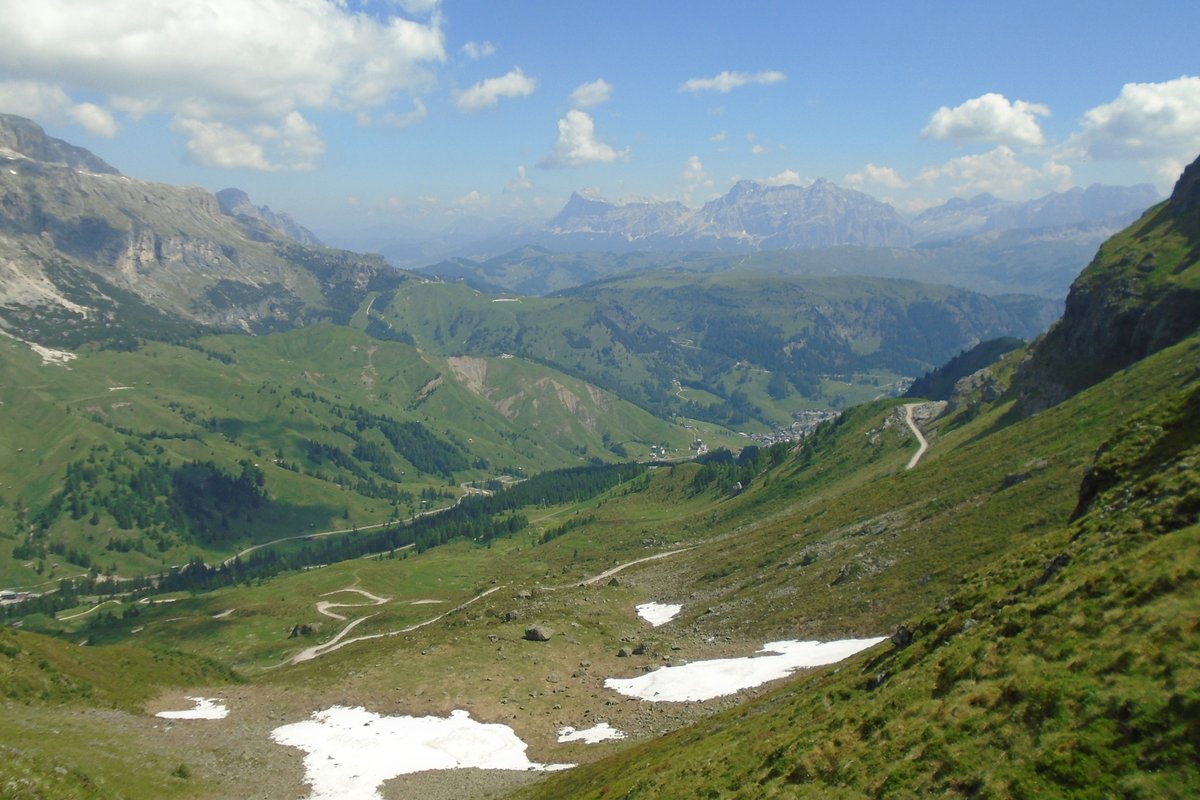
Passo Pordoi
The steady Dolomites classic with 33 hairpins, Coppi's monument and an exposed, windy top — 9.4 km · 6.8% avg
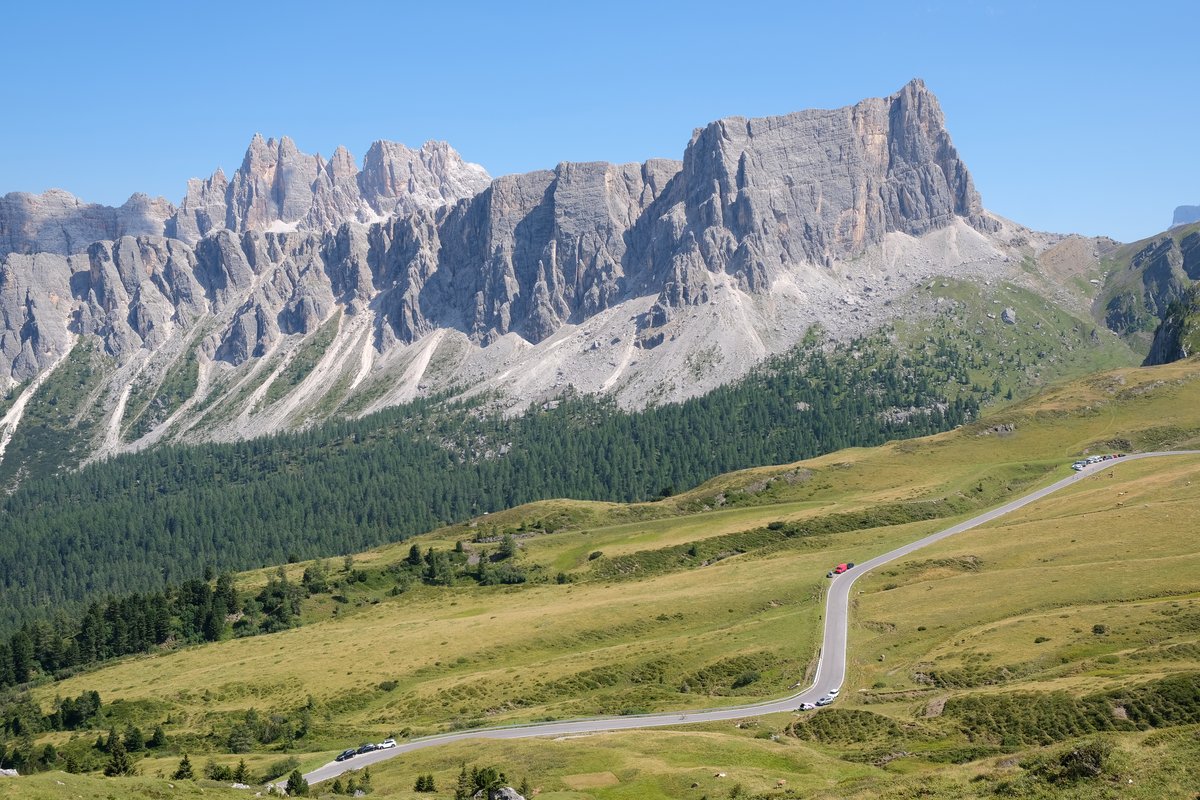
Passo Giau
The Dolomites pass with 29 hairpins and no real rest from bottom to top — 10.1 km · 9.1% avg
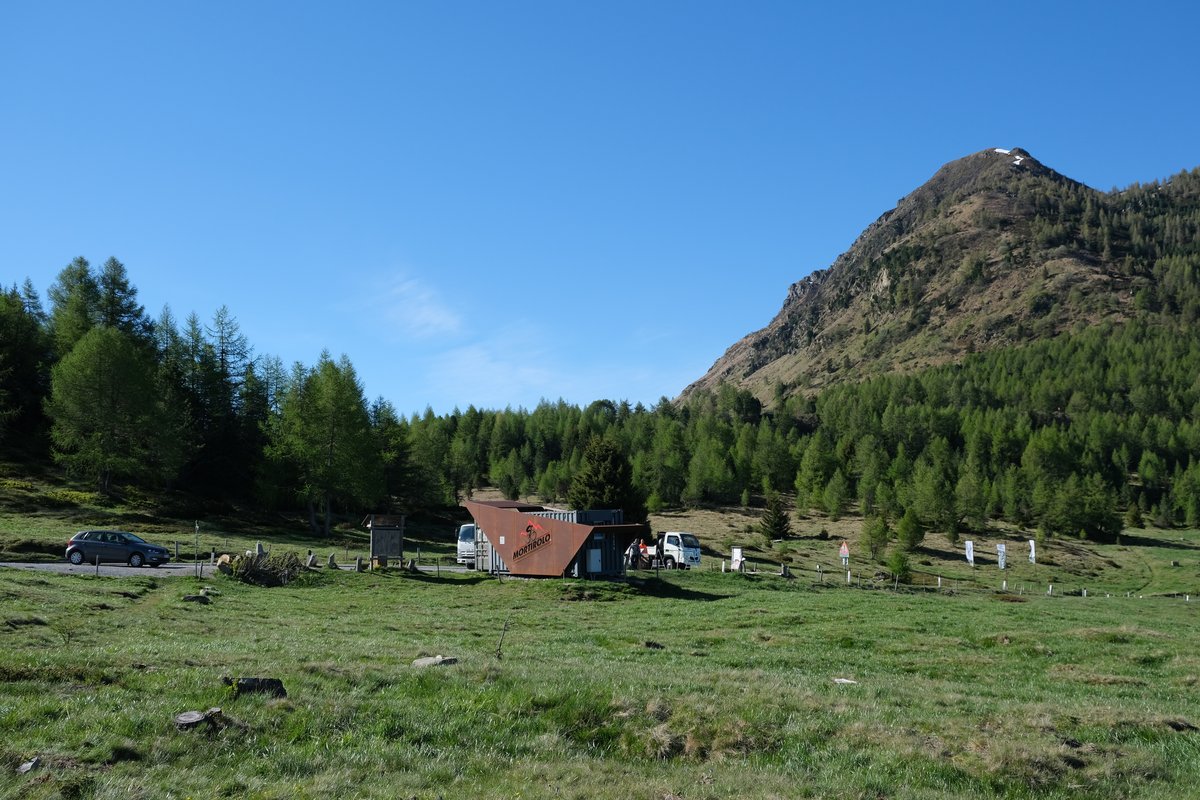
Passo del Mortirolo
The Giro's steepest classic — 12.4 km · 10.5% avg
Also useful: Gearing for Mountain Climbs: Chainrings, Cassettes and Bike Setup for Alpe d'Huez, the Galibier and the Angliru